In case you have been wondering why the displayed games on this homepage vary in their quality or why I complain about a lack of time, you may be able to learn something new from this.
A brief explanation: several people meet somewhere to create games together. These events usually have a time limit and include the planning, design and development of the game. At the end of the event, the games are presented and, thanks to the internet, often published.
Here in Berlin, I have primarly come across two types of game jams. Each one has its advantages and disadvantages:
Analog Games
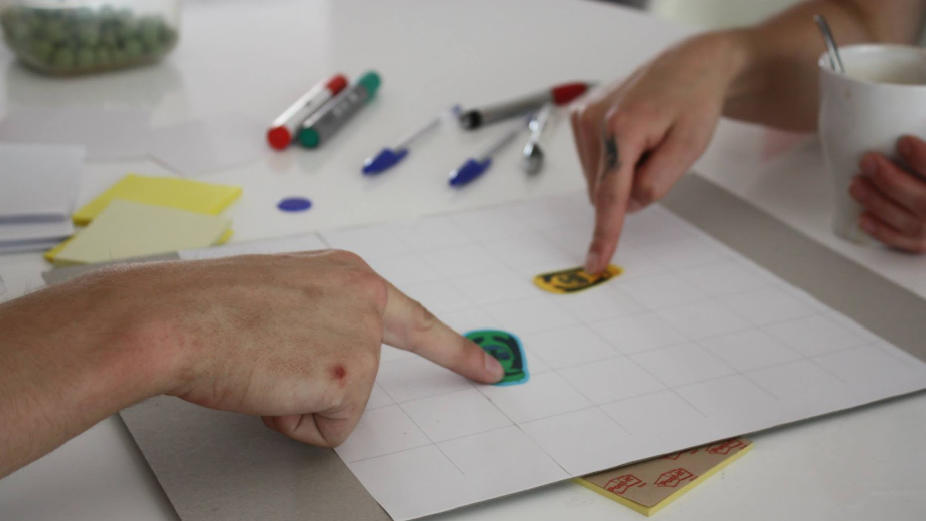
Here, the organisers often give a topic, a mode of operation or just materials to the participants. Accordingly, the teams usually stick to the guidelines. Beginners in particular often find this very helpful. Also, the minimum requirements are extremely low as a result. Of course knowledge about game design is helpful, but in general, no prior knowledge is necessary to participate.
Digital Games
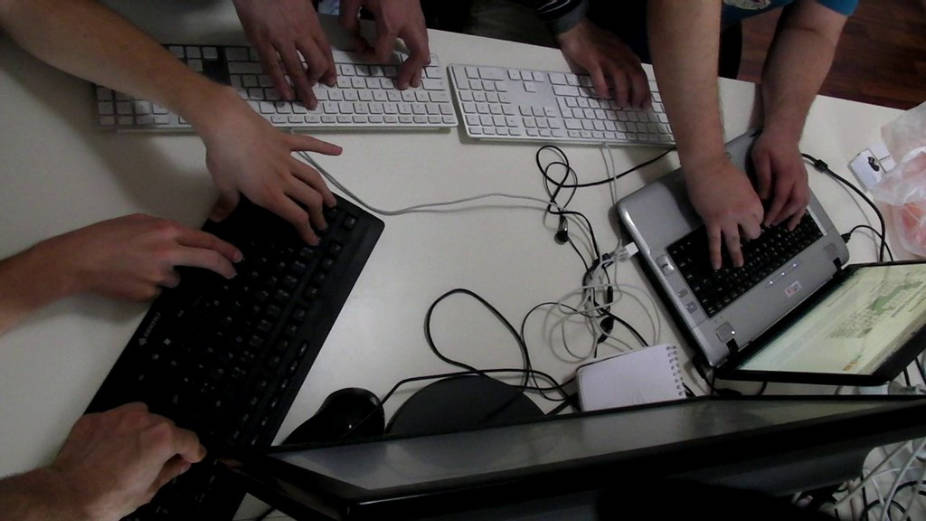
Apart from the fact that these are almost always about PC and smartphone games, the sky is the limit here. While the organisers usually provide the participants with one or two topics, those are mainly intended as a starting point. However, getting started is a bit trickier than it is with analog games. Most participants are programmers who may have to become allround talents during the jam. This is why artist and game designers are extremely welcome as participants. Not primarily for work division, but due to the transfer of knowledge. Still, I have seen twelve-year old children being able to stand their ground in this field. Apart from the fact that a lot of heart is invested in the project, most people come to have fun, gain experience and exchange ideas. Some game jams offer awards and this positive stress may be desirable by some.
Participating in a Game Jam
If you are not lucky enough to know people, the internet may be your best option. Many organisers have their own homepage, smaller groups usually coordinate via social networks. When in doubt, enter "»name of your city« game jam" into a search engine.
I will go to a Game Jam tomorrow. What do I need to know?

Unless specified otherwise, you can assume that there will be no catering. However, these events usually take place close to restaurants or supermarkets. Take some cash or food with you.

Depending on the type of game jam, take your tools with you. Organisers of digital jams usually expect you to bring your own laptop in working order with your preferred software already installed. Electricity is usally no issue, neither is internet access. In the case of analog games, the organisers will usually provide you with all necessary materials.

A positive attitude is always a good thing. So is being punctual, as most game jams follow a set schedule. Some jams last for several days – in this case you should arrange for accommodation. Most game jams have their teams do their own time management. Of course, you are allowed to leave the premises to eat and sleep.
I want to Organise a Game Jam
I asked members of the Berlin Min Jam und Gamestorm Berlin e.V. Team to contribute to this section. Even though different places may have different rules, these points should suffice as a general guideline.

Naturally, you have to tailor the game jam to your target group. If you are new to the scene, it may be best to plan for your own peer group. E.g. a programmer knows best what another programmer needs to work. Once this is done, you can increase your target group step by step.

If you are planning a game jam for next month, start advertising it now! Is it two in the morning and your friend wants to do a game
jam in two months? Then call him and tell him to announce it now!
Many people go to game jams in their leisure time. This means they are unlikely to reschedule other plans for them. Knowing early who
will be there also helps with making plans. Last but not least, it is useful to make sure no other events for your target group take place
on the same date. A job fair for game designers that takes place in your city means less people may come to your game jam.

The location is an important factor. Just like a 'real' workplace, air conditioning will be necessary. You need bathrooms and low levels of noise.

Where do I find a place to hold a game jam? Small groups (max 10 persons) could even find room in a coffeeshop. Of course, reserving tables early is important for this. You can tell the owner that it is for a roundtable (which is often easier than lengthy explanations of the term game jam). Other places to look out for are universities, schools and privately run education centres. Of course, you can also approach companies. However, you need to be careful with this. Not just because cleaning up after yourselves is more critical here – you can easily antagonise future partners by approaching their competitors.

If you, just like many, do not want to provide catering, you should still make sure that your participants can go shopping nearby.
Ideally they would have several options.
Digital game jams also mean that you need to provide electricity and internet access. This brings us to our next point.

How long should a game jam last? It depends. Small events often take 8 to 10 hours. Bigger ones may last up to two days. Jams that last longer than one day need to make sure their participants have a place to sleep. Some of them may be local and stay at their own homes. It is interesting to note that 48-hour game jams rarely produce more innovative mechanics than eight-hour ones. The participants will usually use the extra time to polish and troubleshoot the game.

Structuring the event is a good idea. What is useful depends on the type of game jam.
Analog Games
A stricter schedule is useful in this case. We will assume that the goal is to develop a tabletop game. The plan could look like this:
| 10:00 | meetup | |
| 10:15 | introduction | I am. I do. About one minute/person. |
| 11:00 | introducing the topic | The goal is to develop a tabletop game. The gamers should be able to collect items and improve their character. We hand out a short rulebook on possible moving and fighting systems. Form groups, discuss ideas and present them as a group an hour later. |
| 12:00 | presenting the ideas and working on executing them. | Recommendation: please try to test your mechanics, make a small set of functioning mechanics rather than building a huge system. |
| 14:00 | break | |
| 16:00 | presenting progress so far | Here, participants can receive feedback from others. The organisers get the opportunity to recognise and help weaker teams. |
| 18:00 | presenting the games and letting other groups test them | |
| 19:00 | end |
Depending on the theme, the schedule can be made even more elaborate. These quick feedback loops are mainly for the leader to influence the process to stop teams from developing mental blocks or trying to do too much. Preparation is everything here. Ideally, the organisers will do a dry run beforehand.
Digital Games
Can be approached with a more relaxed plan. A typical one may look like this:
| 10:00 | meetup | |
| 10:15 | introduction | About one minute/person. |
| 11:00 | Choosing a theme | Collecting and choosing themes. |
| 11:30 | execution | Participants form groups independently, think of game ideas and execute them. |
| 14:00 | reminder | Half time break. |
| 18:00 | reminder | One hour left. |
| 19:00 | Presenting the games | Ideally, you will do this using a projector. |
Here, the themes are primarily a starting point and do not have to come from the participants. As you can see, digital games require less strict timelines and maintenance. This, however, is also the reason why I personally think that analog game jams are more beginner friendly.

Team building is also crucial. Have an eye on newcomers. As you can see in the schedule, a quick introduction is part of the plan. It is
meant to break the ice without putting people under pressure. Ideally, people will join teams spontaneously after working on themes. However,
you will also encounter lone wolves who prefer working alone. When in doubt, make one of the organisers form a team with a beginner.
If that is not enough, you can try to combine the introduction with a quick game. Each participant receives five pieces of paper with his
number on it: participant one = five pieces with a 1, participant two = 5x2, … The task is to collect as many numbers as possible. However,
you are only allowed to exchange pieces after a conversation. Suddenly, people will start talking.

Competitive or not? If you have the opportunity to give away a prize or even promote a service or product through a game jam, a competitive
vibe can be a welcome motivation.
For the participants, it comes down to personal preference. Some like the additional kick, others will stay away. This is the main issue:
if you plan to increase the number of attendees, a competition will scare off people who lack confidence.
On the other hand, some people specialise in competing and will bring their experienced teams with them.

Easy to forget but extremely important. What to do in a case of emergency? Where are first aid kits, fire extinguishers, emergency exits? Who do I need to inform if anything happens? Who is liable? Of course, making this information accessible to all organisers makes sense, in case someone has to drop out.

If you plan to do this on a regular basis, documenting the process is a good idea. You can edit it and publish it on a blog, among other
things. It makes sense to take pictures (get the permission of everyone involved first) and film the final presentation.
In the case of digital games, you can ask the participants for screenshots, videos and download links. You can document analog games by
collecting rulesets or stories.

Evaluating a game jam can be tricky. Generally, it is a good idea to ask the participants if they enjoyed the event. However, be specific: "how did you like the schedule" or "what about the location". Of course, your own impression will often be enough, but a second opinion never hurts.
This concludes this article. I would like to thank the teams of


For the support and the pictures.
Share on Facebook Share on Twitter Share on LinkedIn
Game Dev.
,
Game Jam
,
Tutorials